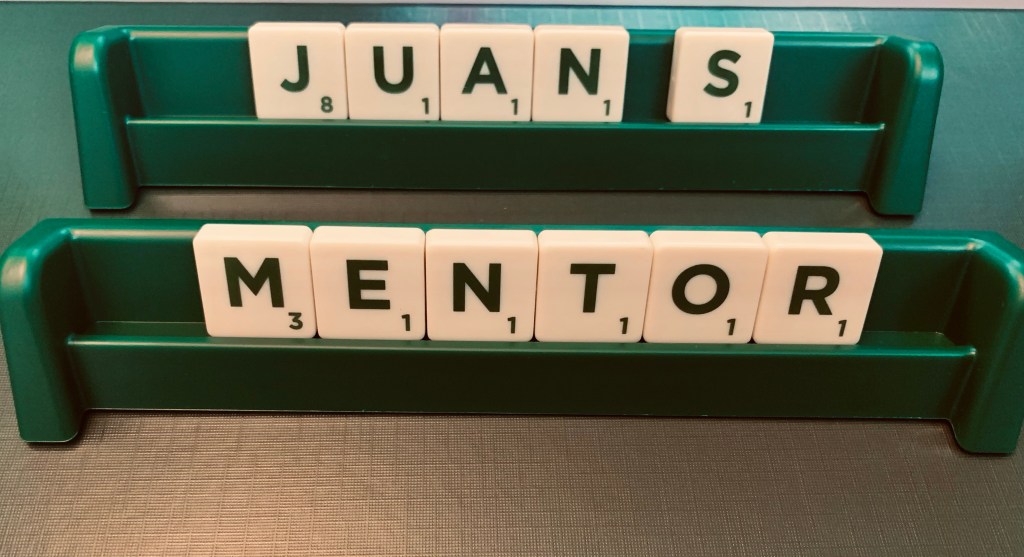
I haven’t posted for a while here. It’s been a busy first half of the year, with pandemic and all…you know…But, it was a good half, though. I truly cannot complain. Family safe and healthy (both in the UK and Uruguay). A job that I really enjoy, secure and stable. Managed to surf more times than expected. And despite the fact that I spend more hours than I would prefer in front of my laptop, it felt a particularly good time for professional growth.
And this feeling has a reason: Mentorship
My experience was twofold: I had, and still have, mentorship as part of my professional development and I had to chance to be a mentor to a group of postgraduate students, as part of a program at the University of Bristol.
Both experiences left me with very valuable knowledge and lessons learned.
This first post will be about ME having a mentor. But, an important part of the mentorship processes includes pass your knowledge along, for the benefit of others. That will be in Part 2 and how I dealt with me being the mentor.
The topic of mentorship, I believe, has a lot of value and it’s not straightforward. I’ll try to KISS these pieces (Keep it simple, stupid) not because of you, my dear reader. Just because it doesn’t makes not much sense to complicate things. Mentorship has happened for millennia . I’m not reinventing the wheel here. This is just my experience as an average human. No golden rules or anything. I just hope this brings value to others in their professional journey and encourages you to find a mentor. It worths the effort.
Three things I learned about having a Mentor
As I said before, I’m lucky enough to have mentors within the organisation I’m part of, as well as outside.
Here, I’ll focus more on the “outside” mentors. Mainly because it is the type of mentorship,from my perspective, that requires a bit more work from the mentee (you, me, etc. btw: I’m not sure if that word exist, but serves the purpose). “In-house mentorship” happens more organically. You generally find yourself learning almost by osmosis from you peers and managers. Mentorship outside of your day-to-day life, require a bit more proactivity. A bit more sitting down and planning.
For the sake of clarity, I’ll keep myself within the boundaries of the “Rule of Three“. It’s apparently more attractive for you, reader. Hope it suits you and feel free to plan and think as thoroughly as you need to prepare for the experience.
Well, that was a long introduction. Let’s get on with it, shall we?
First lesson learned:
- Know about what you don’t know…but you want to learn more about.
Easy stuff? Not for me, but I’m a slow learner. It took me a few years, a handful of jobs in different areas of expertise, different countries, languages and career paths to know what I didn’t know, but wanted to know more about. Not a very straightforward path.
But fear not! This lesson applies regardless whether you find your “calling” right away, or you need to dig deep inside for it to manifest itself.
Sorry, I’m getting too mystical…
The area of expertise that resonated more with me, is the intersection of public policy and connectivity infrastructure development, telecommunications and Internet infrastructure in general. I know a few things about telecommunications and public policy, but when I faced a challenging professional setting, the real professional world basically, the one I want to dedicate a large part of my life, it was harder than expected.
Every time I had to argue in favour of my position in a given setting, particularly with policy makers, I was doing an OK job. I knew my stuff and was quite solid both technically and with public policy aspects. But, I felt always lacking of real world experience. I found myself talking to senior people that had historic, “environmental” data so to speak, and ways of facing problems, that I didn’t had. And that made my arguments much less powerful. I was out of “vibe” in challenging professional surroundings. I felt like a human in Pandora. The planet, not the jewellery, or the woman with the box of Greek mythology.
As in the fashion industry, even in ever-evolving technological contexts that seem to move constantly forward, we have cycles. And experienced people had lived them and learned from them.
My target then became to know what happened before. I needed context. I needed that holistic perspective that, more often that not, only time and countless hours of meetings/calls/books, can give.
“Mas sabe el diablo por viejo que por diablo” the saying goes (translation: “The devil knows more for being old than for being the devil”).
So…I needed context. And in my particular case, regarding telecommunication’s regulation, so I could argue in favour of innovative solutions to build more infrastructure and connect more people around the world. I knew that I wanted to know more about telecommunication’s regulation from a historical perspective, in order to shape the future.
Now, I knew about what I didn’t knew…but I wanted to learn more about. Huzza!
Onto the next lesson learned:
- Pick the right person as your mentor
I know…obvious. Yes it is. You need the “right” mentor. But, as with any other activity that involves social/human relationships, the word “right” has tremendous weight. So let me tell you what worked for me.
Your Mentor has to know stuff you don’t know, and you want to learn more about. As I said, you need to know what you don’t know, so when you hear/read your Mentor, triggers that something in your brain that makes you say “This person really knows their stuff”. That should be relatively easy, because you are probably already immerse in an environment from which you want to learn more about. You are surrounded with many potential mentors.
Now, you might get know several brilliant people that know about your desired field of expertise. But, not all of them have the time, the resources, or even the willingness to be mentors.
Again, apologies in advance for stating the obvious, but first and foremost, you should find a mentor that you respect and very importantly, that you like as a person.
You probably heard about that professor that was an a-hole, but knew more than everyone else in the field. Or that boss that had a golden track record/career. Those people, very intelligent people btw., might know what you want to know more about.
But, trust me, if you don’t have a healthy, professional relationship, you will not take the most out of the advice coming from them . Things might get lost in translation, because your are not in the same “vibe”. You might find yourself not wanting to meet with that person or force yourself to do what they say you should do, just because they “know more than you”. You don’t’ want that. You want trust, you want to feel the willingness to share, be able to talk openly/bluntly/discreetly with your mentor. Engage in meaningful conversation and discussions.
Only those few filters will probably make your candidate’s list shorter. Also, the right person will most likely need time to dedicate to you. If you find a good Mentor, but they are on the fence about their schedule, maybe it would be best to try with someone else.
BUT, and this is a big BUT, even if you find someone that seems totally over-scheduled, don’t be afraid to ask. My mentor is a brilliant person, extremely busy, but found the time to meet with me 1 hour a week for 6 months (now we still meet! but less often). My mentor is really in “vibe” with the professional environment and really knows the stuff.
I asked and he said yes to the mentorship program I had in mind.
Which brings us to the final lesson I learned:
- Make a mentorship plan…but don’t be afraid to change it.
I know, what I want to know more about, I have a person willing to mentor me in the said area of knowledge and we have decided a plan on how to move forward.
We started the plan, and then…life happened.
I kept learning new things in my day job. I attended more seminars, more lectures. The plan I had in mind, still made sense, but now I wanted more! And my mentor had similar experiences, bringing new topics of discussion or research to the table.
I wanted to know more about historical context telecommunications regulation: Spectrum allocation – traditional and dynamic -, 5G, TV White Spaces, WiFi6, licensing frameworks, the global status-quo on connectivity and how to improve it. And I did!
But, I also learned about economy through books my mentor recommended. I learned about advocacy methods and how to convince people (the right way, nothing shady). I read more policy books outside the field I was interested in. I learned about mapping tools and open standards. I took training and I had discussion with my boss and colleagues that I was not planning to have.
We had a plan to work with, but it changed, and it was great!
Make sure you plan and you are flexible at the same time.
Mentorship is a dynamic, enriching professional and personal experience, if you want to know more about something, chose the right person to guide you, plan ahead and enjoy the ride.
 Tech Tide Talk
One response to “Mentors matter [part 1]”
Thank you for your contribution. Very interesting article. 👏
LikeLiked by 1 person